
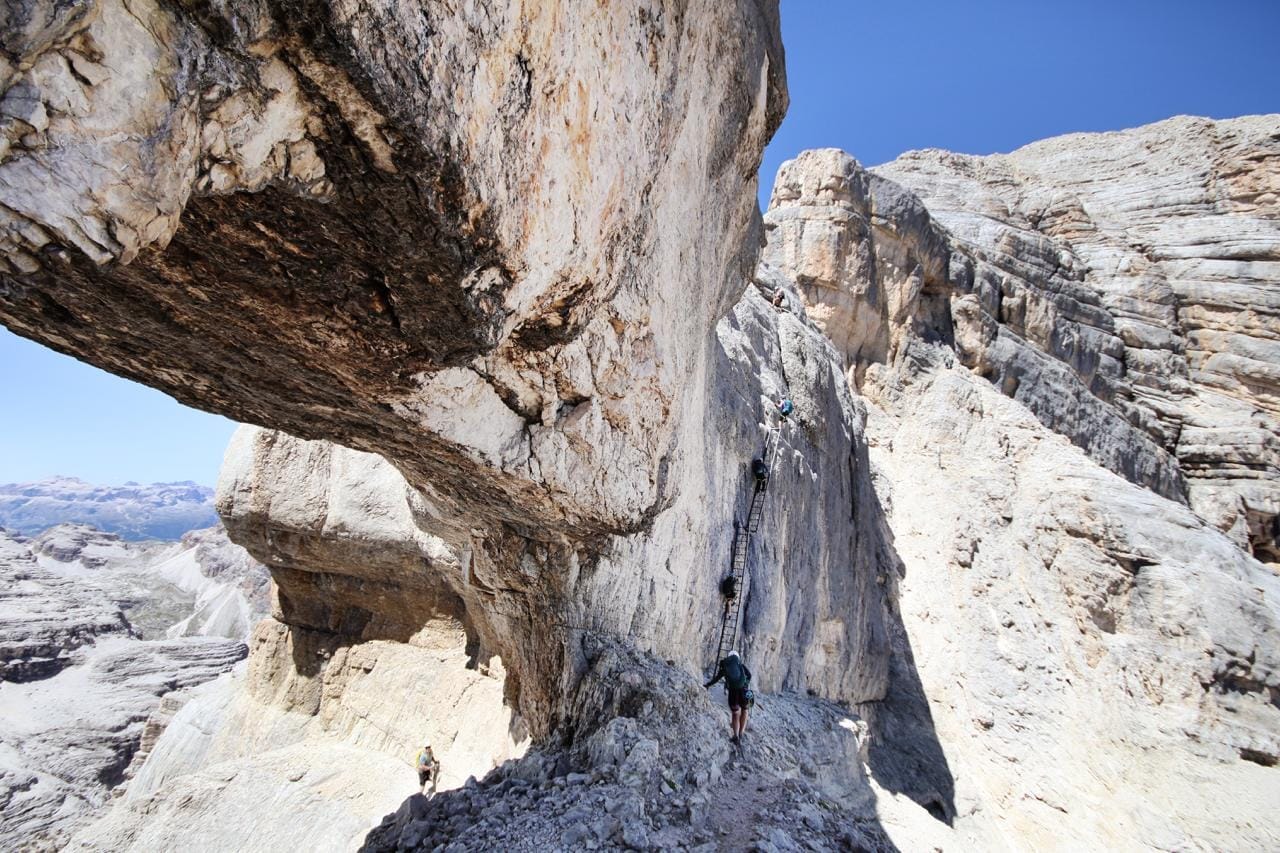

If I had to choose just only one favorite via ferrata route out of all of them, it would definitely be the trail leading up to the summit of Tofana di Mezzo (3,224 m). This route combines Via Ferrata Giuseppe Olivieri and Via Ferrata Gianni Aglio and it’s insanely exciting! Difficult and exposed sections, ladders, natural rock features you’d hardly to find on other via ferratas and tons of fun climbing. I’d even recommend saving Giuseppe Olivieri and Gianni Aglio for later, because after completing this Dolomites route all the way to Tofana di Mezzo – others might feel a bit boring!
General information about Via ferrata Giuseppe Olivieri and Gianni Aglio
- 📍 Mountain Group: Tofana Dolomites, Italy
- 🧗♀️ Route Difficulty: C/D*. One section is rated D, but it can be bypassed.
- ⏰ Route Duration: 6 hours
- 📏 Total Distance: 6 km
- 📈 Elevation Gain: 1,200 m
- 🔗 Cable Length on Route: 800 m
- ⛰️ Highest Point of the Route: Tofana di Mezzo (3,243 m). The third highest mountain in the Dolomites.
- ⬇️ Descent: Via the Tofana – Freccia nel Cielo cable car. In summer, the last cable car leaves at 16:30.
* For more information on via ferrata difficulty levels, required gear and preparation, read our article: Via Ferrata: What You Need to Know Before Starting.
** The highest summit in the Dolomites is Marmolada at 3,343 m.
Route Map
Via ferrata Giuseppe Olivieri and Gianni Aglio stages
This route covers two via ferratas – Giuseppe Olivieri and Gianni Aglio. After the first one, you can decide whether to continue further or head back down to Rifugio Giussani or Rifugio Pomedes. Below you’ll find the route stages and details to keep in mind when planning your trip.
Getting there
🅿️ Parking: Rifugio Angelo Dibona 📍
The route starts at the Rifugio Angelo Dibona hut. You can drive right up to it by car and leave it for free in a large parking lot. We arrived the evening before and spent the night at the hut, which allowed us to get an early start on the route.
If you are staying in the town of Cortina d’Ampezzo, you can get to Rifugio Dibona by taxi.
Depending on how you choose to get to Rifugio Angelo Dibona, it will determine where you need to ride the cable car down. See the section Stage 4: Descent.


Approach of the Via ferrata Giuseppe Olivieri
From the Rifugio Angelo Dibona hut, a fairly comfortable path leads to Rifugio Pomedes. From Rifugio Pomedes, a gravel trail climbs up to the start of the first via ferrata—Giuseppe Olivieri, marked on signs as Ferrata Punta Anna (as it leads up to the summit of Punta Anna).
Stage 1: Via Ferrata Giuseppe Olivieri
Once you start climbing Via Ferrata Giuseppe Olivieri, the route gradually gets steeper and soon starts going straight up in a vertical line. The ferrata is well secured with steel cables, but it’s very exposed, so it’s super important to be comfortable with heights. Quite a few sections require relying heavily on upper body strength because there isn’t anywhere comfortable to place your feet. And while the climbing is definitely not easy, it’s ridiculously fun. It’s also popular, so there will definitely be people both ahead of you and behind you. There isn’t much room to overtake or linger for long on this route, so you need to maintain a steady pace until the first cable section ends.


After finishing the first cable section, you’ll reach a ridge leading toward the second via ferrata cable section. On the ridge, you can turn left toward Rifugio Giussani. This is the first escape point if you don’t want to continue the route. From Rifugio Giussani, you can easily descend back down to Rifugio Angelo Dibona.
After climbing through the second cable section, you’ll find yourself on the Punta Anna plateau. The trail clearly splits here and red markers lead further toward the summit (“cima“) and Via Ferrata Gianni Aglio, or loop down toward Rifugio Pomedes. This is the second escape point if you don’t want to keep going. At this spot, you should evaluate how long you’ve been climbing and how much time is left until the last cable car. If you don’t make it in time, you’ll have to descend back down the same ferrata (not recommended).
Stage 2: Via Ferrata Gianni Aglio
After the Punta Anna plateau, as you head up the trail, the start of the second via ferrata Gianni Aglio is marked by one of the route’s many ladders and is visible from afar. Once you climb up the ladder onto a steep rock wall, the trail becomes even more interesting. Cables are there one moment, gone the next. In places, you have to cross gravel paths – ascend, descend. Because of this, it’s super important to watch the trail markers and navigate carefully until you reach Torre Aglio.
Once you reach Torre Aglio, the real fun begins. First, you have to climb up the tower on a tough C/D section. It’s pretty slippery, so you have to keep a lot of your weight on your hands. From there, the route splits into two parts:
- The first part leads to the summit of Torre Aglio. This is a D-rated section, and it’s optional, as you descend back down the same way and then continue along the second part.
- The second part continues along the via ferrata and goes around Torre Aglio. This section is the absolute highlight and completely breathtaking, as you have to traverse a narrow ledge where there’s barely any room to place your feet. Below you – a sheer drop! This is also the crux of the whole route if you don’t climb the Torre Aglio and gets mentioned a lot in other via ferrata guides. After reading them, I was pretty anxious about how we’d make it through, but in reality it wasn’t as scary or hard. It just took focus and we all passed around Torre Aglio easily.
After Torre Aglio the climb continues to be exciting and fairly steep. Soon enough, another impressive feature appears – a natural rock arch. The route leads right through it!


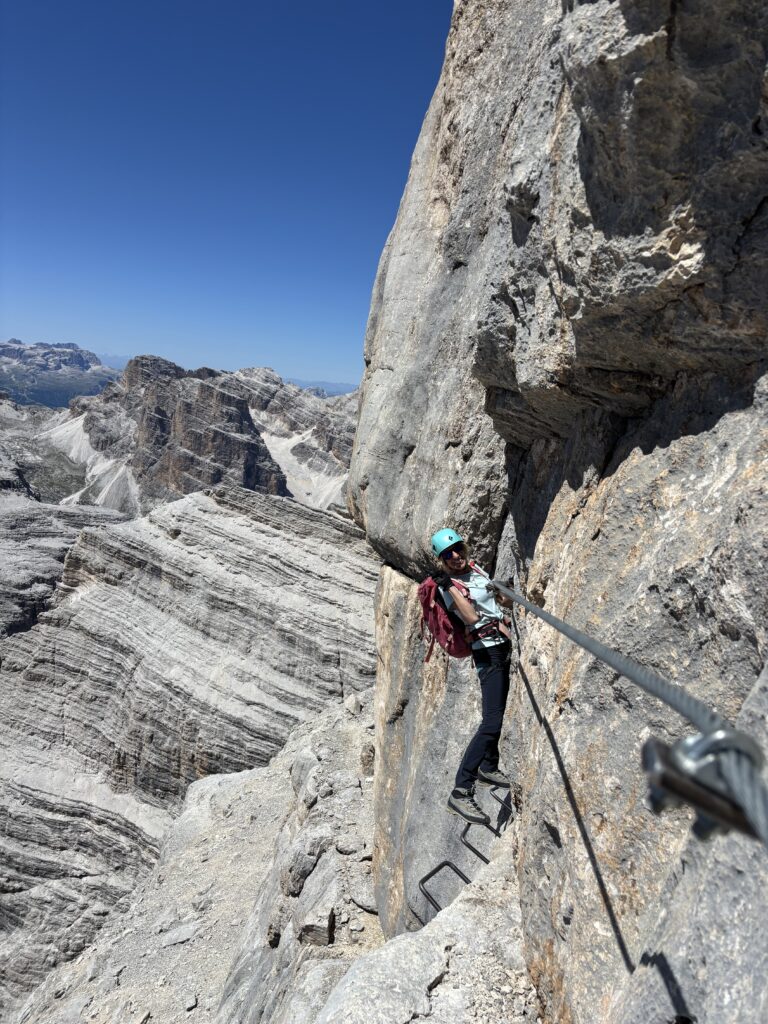
Stage 3: Tofana di Mezzo Summit
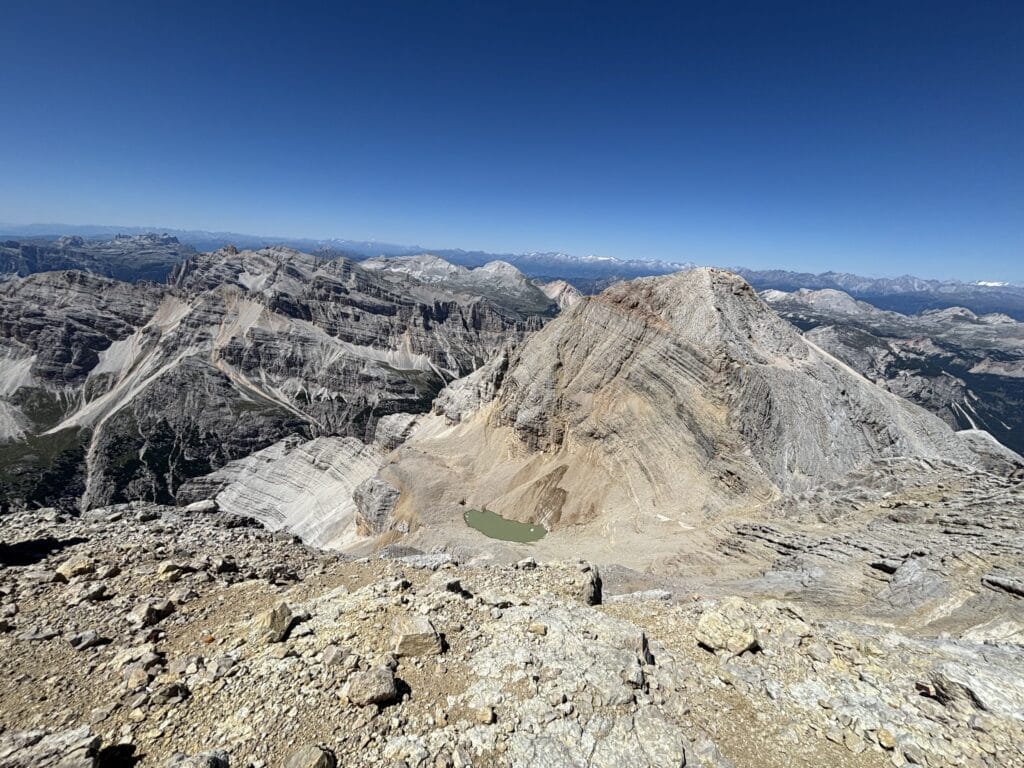
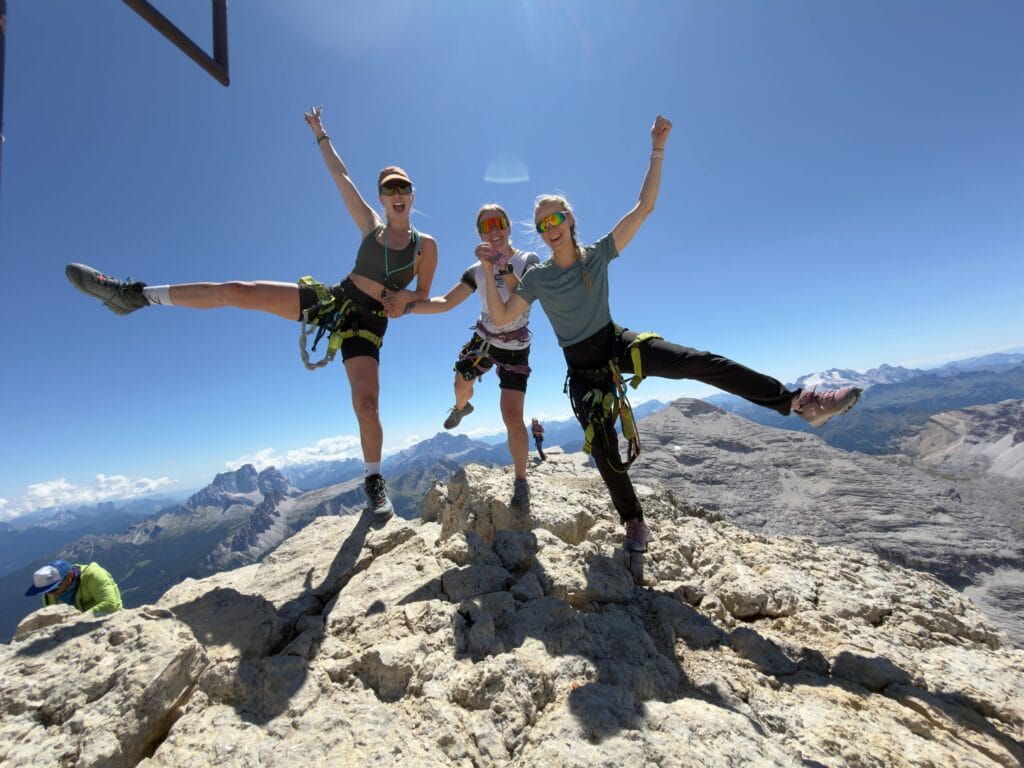
Once the via ferrata cables end, the route continues toward the summit along a gravel trail. For me, this was the least enjoyable part of the route because some of the scrambles are quite steep with sheer drop-offs on the sides. I really wished for safety cables and was so glad to have friends around to give me a hand here and there. But the views at the summit are unreal! And the feeling of reaching the top – amazing!
Stage 4: Descent
You can descend from Tofana di Mezzo using the Tofana – Freccia nel Cielo cable car. A comfortable, wide trail built for tourists leads from the summit right to the cable car station. Unfortunately, there are no other viable options for the descent. So if you’ve started Via Ferrata Gianni Aglio, it’s super important that you finish it in time for the last cable car.
Along the other side of the mountain runs Via Ferrata Formenton, which used to be an option for descending. However, due to rockslides, this via ferrata is closed and descending via this route would be extremely dangerous. So, to repeat—it’s crucial to make it to the cable car, because otherwise you’d have to climb back down the same Via Ferrata Gianni Aglio to the Punta Anna plateau, and from there to the Pomedes hut.
The cable car descent offers three stop options, so keep in mind where you left your car and where you want to end up after the hike. The two most convenient drop-off options are:
- Ra Valles. This is a middle station where you can get off if you left your car at Rifugio Dibona. From here, it’s about a 2-hour walk down to Rifugio Dibona.
- Cortina d’Ampezzo town. This option is convenient if you have a second car parked at the bottom station, allowing you to drive back to Rifugio Dibona to grab the first car.
If you’re staying in Cortina d’Ampezzo, you can also just take a taxi to Rifugio Dibona at the start. That way, you take the cable car all the way down into town and don’t need to head back up to Dibona to retrieve a car.
- Last cable car in summer: 16:30
- Cable car frequency: Every 15 minutes
Where to Stay?
Since the route to Tofana di Mezzo is long, it’s best to stay as close to the starting point as possible so you can get an early start. The most convenient location is Rifugio Angelo Dibona. This mountain hut is accessible by car and offers plenty of amenities – Wi-Fi, unlimited hot showers, and a delicious dinner. At other huts, showers are usually timed/paid and Wi-Fi or cell signal is practically nonexistent. Staying in a mountain hut has its own unique charm, especially in the evenings when the crowds disperse, so I highly recommend the experience. You can make a reservation directly on the Rifugio Angelo Dibona website.
If you’d rather spend the night in town, the most convenient hub is Cortina d’Ampezzo and its surroundings. Although Cortina is considered the capital of the Dolomites and accommodation here can be quite expensive, booking early on Booking.com can help you score better deals.
- Option 1. With our group of 9 people, we fit comfortably into the Spacious Alpine Retreat & Parking apartment. The apartment includes a parking spot in an underground garage, which is a massive bonus when staying in Cortina d’Ampezzo. It’s also right in the center, surrounded by plenty of cafes and restaurants within walking distance.
- Option 2. Another great apartment a bit further from the center of Cortina d’Ampezzo (about a 10-minute walk) is Via Cantore Exclusive Stay. It’s suitable for groups of up to 6 people, featuring 3 bedrooms, a living room, a kitchen, and a large balcony overlooking the mountains. It has everything you need for a comfortable stay, including laundry detergent, cooking spices, etc.
Tips and Tricks
- Choose a day with perfect weather for the Via Ferrata Giuseppe Olivieri and Via Ferrata Gianni Aglio route to the summit of Tofana di Mezzo. The path is long, and you will be at high altitude in exposed areas for an extended period – places where you definitely wouldn’t want to get caught in afternoon storms. Once you start climbing the Gianni Aglio via ferrata, there are no more escape options.
- Keep an eye on the time. If you haven’t finished the Via Ferrata Giuseppe Olivieri by 13:00, you will likely not make it through Via Ferrata Gianni Aglio in time for the last cable car.
Other Nearby Routes
- Via Ferrata Averau – A. Suitable for beginners.
- Via ferrata Ra Gusela – A. Suitable for beginners.
- Via ferrata Strada degli Alpini – B. Suitable for beginners.
- Via Ferrata degli Alpini al Col dei Bos – B/C. Suitable for those who already have via ferrata experience.